Sunday, 11 October 2009

How to clean and care for your brass


Before we start on how and when your brass should be cleaned I’ll endeavour to explain the complexities of the metal and why some brass is yellow and another is nearly white.

The dictionary definition of brass is that it is an alloy of copper and zinc but the percentage of zinc and copper can vary greatly giving us many different types and hues of brass. Types range from Cartridge Brass (30% zinc) to Tombac which has a 15% zinc content and is used mainly in jewellery. As you can imagine the higher the copper content the darker the brass will be whereas higher zinc content will give the brass a whitish yellow appearance.When first cleaned your brass will in all probability look very pale but this shouldn’t lead to concern as when it is left exposed to the elements for a few days it will darken or tarnish and will take on a rich mellow patina. Modern brass hardware is normally lacquered to eliminate tarnishing but in time the lacquer is prone to peeling or blistering unless it is put on through Electrophoresis.


Our personal view is, we don’t really like lacquering and prefer to see door furniture build up a mature patina over its lifetime. That isn’t to say we don’t like clean hardware but there are ways to have the best of both worlds and that is the reason for this blog.
1) Never use anything abrasive on your brass such as wire wool or a scouring pad; it will leave marks, I promise.
2) Before you decide to use any of the market brands of metal polish try some warm soapy water and a soft nail brush. This will remove the dirt and grime as well as clean your brass, dry off with a lint free cloth and you’ll see straight away what I mean about patina. The surface exposed to cleaning will be shiny whereas the crevasses will be slightly darker giving an aged appearance, over time cleaning like this will give your hardware that mature mellow appearance I mentioned above.
3) There are various natural and household products that are quite effective when cleaning any stubborn stains and grime on brass, here are a few we would recommend.

o Lemon - Cut a lemon in half and remove any visible seeds, sprinkle a little household salt on to a board and dip the cut side of the lemon into the salt, holding the rind gently rub your brass surface with the cut face of the lemon (you may need to dip back into the salt occasionally) then wash or wipe with warm soapy water before wiping dry with a clean dry cloth.
o Sauces - Acidic sauces such as Ketchup and Worcestershire Sauce are also good alternatives for cleaning brass. Using a clean, damp cloth, gently cover the brass with the sauce and leave for about a minute, then using another clean cloth wipe it off, again wash with warm sopy water and then dry witha soft clean cloth. It will give a good result but not as good as lemon and salt.
o Toothpaste – Although not as effective as the above two, toothpaste is a gentle way of cleaning hard to get at areas on any brass objects, even more effective when using a toothbrush
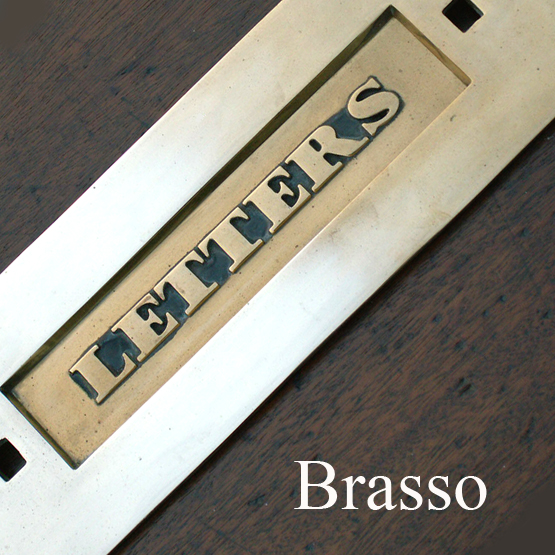
o Onions, salt and vinegar and ammonia will also be quite effective when cleaning brass but if the above doesn’t meet your needs then you may want to try using a good recognised metal polish such as Brasso, remember to read the manufacturers instructions and keep away from naked flames.

If you are an eco-warrior or just like to save a few pence then lemon and salt will be your best route to shiny door hardware, if you are not, then we recommend a metal polish along the lines of Brasso. When using any of the above it would be advisable to wear something to protect your hands such as rubber or latex gloves.

Aftercare – When your brass has been cleaned and is dry you can protect it with a beeswax furniture polish spray, just a light spray and wipe off any excess. This will leave a thin coat of beeswax on your brass and will extend the time between cleaning.

Saturday, 10 October 2009

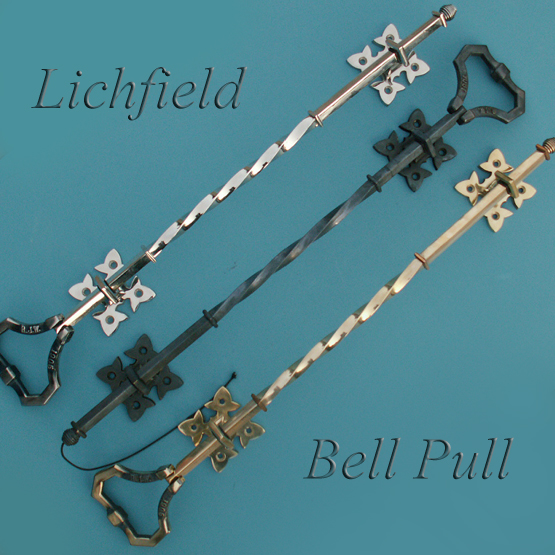
Butlers / Servants Bell - Fitting

If you are installing a complete Bell Pull system,  we advise that before you fit the Internal Bell and any pulleys required you fit the external bell rod as shown in our previous blog


Parts List
Bell assembly – Extension pulleyDirectional pulley – Nylon cord – Wall plugs and screws

Tolls Required
Drill – 8mm masonry drill bit – Slotted screwdriver – Small hammer – Scissors

Fitting Instructions
Step 1 – Mark the position of the two holes in the wooden fixing plate (A) on the Butlers Bell. For best results the hole in pull bar (i) should be at the same height as the bottom of the V in the pulley wheel in which the cord runs (try to keep the cord horizontal) Drill two 8mm holes, plug and secure fixing plate (A) with the screws provided.
Step 2 – Connect the pull cord to your bell pull and thread it through the pulleys you have inside the house. Tie the loose end to the hole in pull bar (i) using a double knot. Ensure it is captive and taut.


Step 3 – Test your bell pull and adjust cord tension as necessary. Cut off excess cord using sharp scissors when satisfied.

Your bell pull is now ready for use.

Step 4 – (optional) Fix pulley (B) if your bell cord requires more support.

Step 5 – (optional) Use pulley (C) if you need to change the direction in which your pull cord runs from vertical to horizontal. Before fitting, ensure that the bottom of the V in the pulley wheel is aligned both vertically and horizontally with other pulley / pull points.

Cleaning
Dust periodically with soft dry cloth.

Tuesday, 29 September 2009

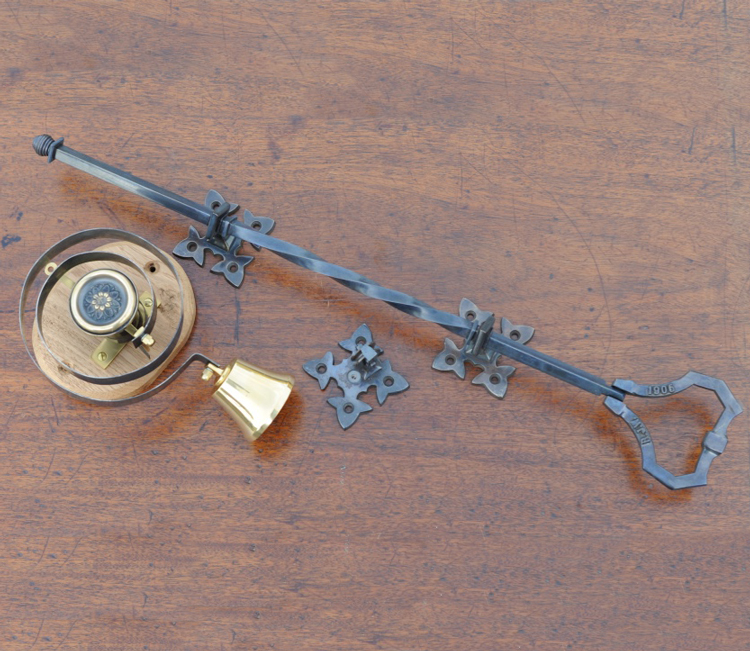
Victorian Bell System - Winchester Bell Pull / Fitting

Tools Required
Drill - 6, 8 and 10mm masonry drill bits - Scissors - Small hammer - Slotted screw driver - Spirit level - Small round file - Junior hacksaw

Before you start
1. Decide upon the height and location of your external Winchester Bell Pull and Internal Butlers Bell
2. The screws and wall plugs supplied are only suitable to use in solid walls. If fitting to other types of wall please source suitable fixings from your local hardware store.
3. Ensure there are no hidden service pipes or cables where you intend to drill.
4. The external fittings MUST be fitted first. 

Fitting Instructions 
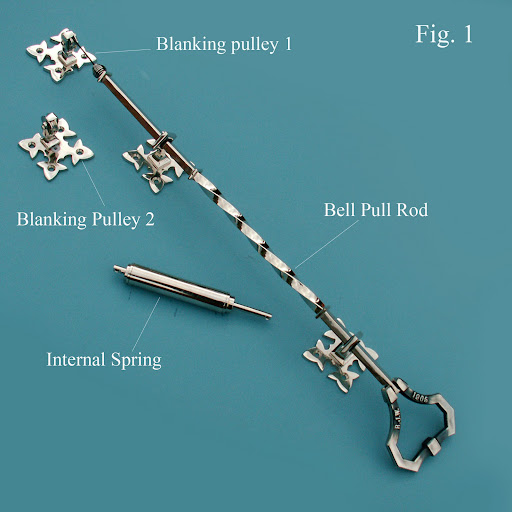
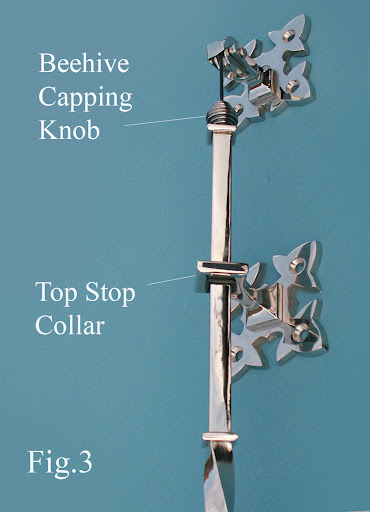
Step 1 - Unscrew nut (i) located on the top of  bell rod and remove bracket (A)
Step 2 - Mark the position of the four holes in bracket (A) on the brickwork

Step 3 - Hole (ii) in bracket (A) allows your bell cord to pass through the brickwork. Drill this hole using a 10mm drill bit. Step 4 - The remaining three holes are used for fixing bracket (A). Drill these with an 8mm bit to a depth two millimetres deeper than the length of the wall plugs provided. Tap the wall plugs into each of these holes. Before securing bracket (A) with the screws provided, pass the cord through the hole in the top of nut (i) and tie a knot in end (cutting off any excess) so the cord is now captive inside the nut. Continue to feed the loose end of the bell cord through the nut locator, over the pulley wheel, through the hole (ii) and the brickwork. When most of the cord has gone through the wall, wrap the remaining cord around the pulley wheel bracket at the top of the bell rod to stop it being pulled back through. Secure bracket (A).
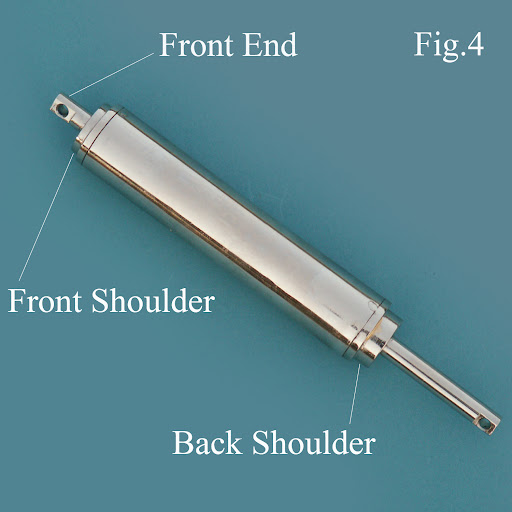
Step 5 - Re-assemble the bell handle, spring and nut removed in Step 1.
Step 6 - Position bracket (B) approximately twelve millimetres above the square shoulder of the bell pull handle. Mark the location of the two fixing holes. Drill the holes using an 8mm bit. Plug and secure with screws provided.

Step 7 - Position bracket (C) mid-way between brackets (A) and (B) and repeat fixing procedure. 
Step 8 - The brass tube supplied acts as a liner in the brickwork and helps protect the bell cord from dust. From inside the house, feed the cord through this tube and push it hard into the hole so it meets bracket (A). Mark the tube where it emerges from the wall. Remove the tube and cut it to length. Replace the tube ensuring that it sits flush with the inside of the wall and does not protrude
Step 9 - Thread the bell pull cord through the hole (iii) in blanking pulley (D). Place the blanking pulley in position over the hole, ensuring the wheel of the pulley is running in the right direction and that hole (iii) is central to the brass tube. Mark the position of the three fixing holes and drill with 6mm bit. Plug each hole and secure the pulley with the screws provided

If you order our Internal servants bell it is supplied with an extension pulley and directional pulley, extra pulleys are available as separate items. 

There may be occasions that you want to lock your bell pull - may be when you go on holiday. You can do this by tightening the grub screw located on the side of 'Bracket B' (see in photo opposite) using the Allen key supplied but remember that adjusting the screw in or out will affect the smooth running of the rod.

Sunday, 27 September 2009

Rim Latch Emergency Release - Fitting


Parts List
Rim Latch and keep – Screws - Emergency release catch

Tools Required
Drill – 12mm & 7.5 drill bits – Slotted screwdriver – Rule/ tape measure – Pencil – Junior hacksaw

Fitting Your Lock
Step 1 – Decide exactly where you intend fitting your rim lock or rim latch and offer it up to the edge of the door. Check to see if there is sufficient clearance between the door and door frame to allow you to secure the lock. Let return of lock into edge of door, as necessary.
Step 2 – Mark the centre of the square hole required for the door knob spindle using a pencil. Drill this hole using a 12mm drill bit.
Step 3 – Offer the lock back up to the door and fit your spindle and door knobs. Secure your lock to the door using the screws provided.
Step 4 – Close the door and mark the position of the keep on the door frame. Let the keep into the architrave / frame as necessary, ensuring that the thumb latch is able to slide into the keep. Secure using the screws provided.

Fitting the Emergency Release
Step 5 – Carry out steps 1-3 above, then remove the rim lock from the door and place it face down on a clean flat surface  
Step 6 – Fold the tracing paper template (provided) towards you, along the dotted line. Place the template no the back of the lock, ensuring that it sits accurately over the pre-drawn line. Mark the centre of the square spindle hole, all the screw holes and the emergency release slot on the tracing paper.
Step 7 – Now place the template tight up to the edge of the door in the position previously occupied by your lock. Ensure that the template is the right way up and that both the spindle and the screw hole centre marks line up with the holes you have already drilled. Check, re-check then mark the centre of the emergency release slot on the door, through the tracing paper. Drill this hole using a 7.5 mm drill bit.
Step 8 – Cut your emergency release bar to the correct length – allowing for BOTH the thickness of you door and the section of bar that needs to be located inside the slot in the back of the lock. 
Step 9 – Push the emergency release bar through the hole you have drilled in the door (from the opposite side to the lock). Place the round emergency release cover plate over the slotted end of the bar and secure using the two screws supplied. Offer the rim lock up to the door, ensuring that the release bar locates in the slot on the back of the lock. Secure the lock using the screws provided and fit your door knobs
.Step 10 – Check that your emergency release works. (Please note that your emergency release ONLY operates to pull-back the catch, not the other way around – that is to say that you can’t lock the door using the emergency release). 

Your rim lock and emergency release is now ready for use.

CLEANING
Spray periodically with a good quality furniture polish and dust with a soft, dry, clean cloth. (N.B.) Cast iron rim locks are sprayed with silicone to protect them from moisture. You may wish to remove any excess spray with a dry cloth or tissue before fitting. Cast iron locks should NOT be used externally or in very damp conditions)

These fitting instructions are the same for all of our rim locks and rim latches, bearing in mind only the latches have the emergency release.


Sunday, 5 July 2009

Inside the Period Ironmonger


Hi this is our blog and on it we aim to let you inside our world, our lives our business and some useful tips and news regarding ironmongery.

We are Tom and Kotti and together run our internet company, The Period Ironmonger. It all started when we bought an eight bedroomed Victorian Vicarage which needed complete rerurbishment. We wanted to restore it in an authentic way with quality products, without breaking the bank. Enter Ronnie Wooton, an all but famous character in the world of reclamation;. add to the equation Fez Labady, who had teamed up with Ron some 12 years earlier. They were nearly as enthusiastic about our restoration project as we were and between us wonderful items were sourced, marble fireplaces, a cast iron ceiling rose and so on. Then came the door furniture, it was so difficult to source sets of original rim locks, latches and door knobs that they started making them; all to original designs and in the traditional way. We have grown and developed our range since then and have now been trading for nearly six years. We have worked hard to develop the business with a lot of  work  carried out in the evenings and at weekend.

Well, the kids grew up and moved out and we moved to North Shropshire in 2006; apart from missing the children we love our country life. We have four children, Emma, Kelly (who became a mom on 7th August this year,  Steve and Laura who is about to become a mom in December. We have no less than four dogs and Kotti has her horse Boswell in the paddock next to our house.

We started our blog to help answer some of the many questions we get through on our website regarding new and reclaimed ironmongery. How to look after it, how to clean it and how to renovate it.

We hope the combination of our ongoing story and the tips we can offer will be of interest to you. We will put some pictures on here soon so you can see who we're talking about